A catalogue you can walk through instead of download.
Balerco designs, manufactures and installs playgrounds across Bogotá and the rest of Colombia. The work is physical, specified and bought by institutions — and almost all of it was being explained one attachment at a time. We built the three pages that do the explaining.
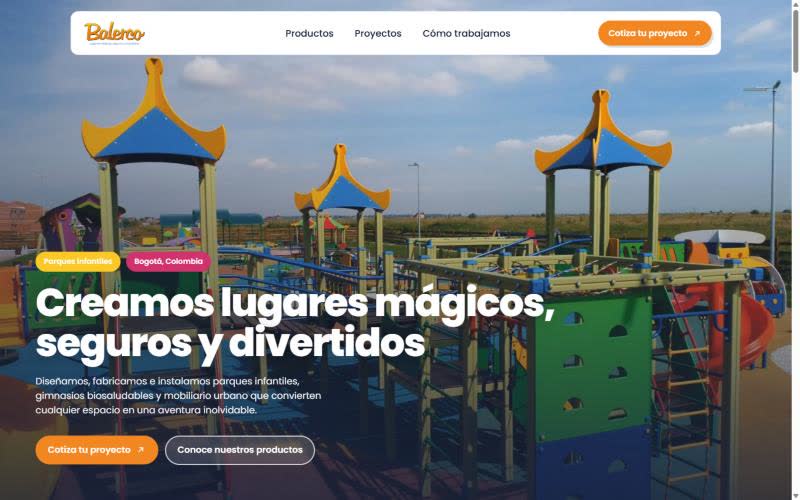
The homepage, live at balerco.co
The range is enormous, and it was travelling as an attachment.
Balerco does not sell one thing. It sells four lines — parques infantiles, gimnasios biosaludables, mobiliario urbano, superficies de seguridad — to buyers who are nothing like each other: a construction company specifying a residential block, a school, a caja de compensación, a borough procuring public space.
Every one of them wants the same two things before they will take a call. They want to see the range, and they want to see that it has been built before, here, by these people. Neither was answerable without sending a file. The catalogue travelled as a PDF and the proof travelled as photographs in a chat.
There was a second problem underneath that one. A company whose customers find it by searching parques infantiles Bogotá has to be findable that way, and a catalogue inside an attachment is invisible to a search engine. Whatever got built had to be a real, indexable site rather than a brochure in disguise.
Let the buyer open the range without leaving the page.
The four product lines are the spine of the homepage, built as an accordion that expands sideways: four coloured panels, one open at a time, each holding its description and the kind of pieces it covers. It reads as a catalogue you walk through rather than a list you scroll past, and it keeps the whole range on one screen — which matters, because most buyers arrive wanting one line and leave having seen that there are four.
Below the panels, twelve sector names ride past on a ribbon: constructoras, colegios y jardines, alcaldías y espacio público, conjuntos residenciales. It answers the question a buyer is actually asking, which is not “what do you make” but “do you work with people like me”.
Proof got a page of its own, and only real installs are on it: parks Balerco designed, built and put in the ground in Bogotá and other Colombian cities, including public-space work with the IDRD. Stock photography and third-party installations were left off deliberately — on a page whose whole job is proof, a borrowed image costs more than an empty slot.
The third page is the process: design, manufacture, installation, maintenance. Four steps in order, because an institutional buyer is signing up to all four and wants to know who is responsible for each.
The hero is a video of a finished park that shrinks into a card as you scroll — tied to scroll position rather than to a timer, so it tracks the hand instead of running away from it. The whole thing is hand-coded, no page builder, set in Poppins at the client’s request to match their existing material, and it ships with its own sitemap, robots file and per-page titles so the search that was the point can find it.
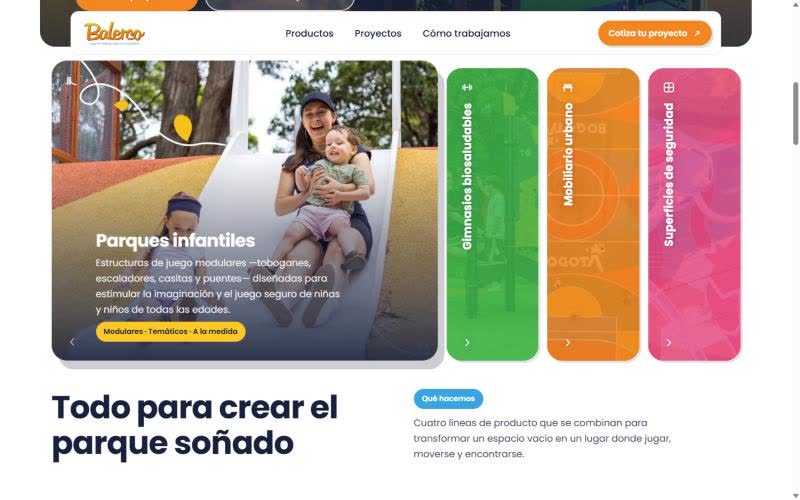
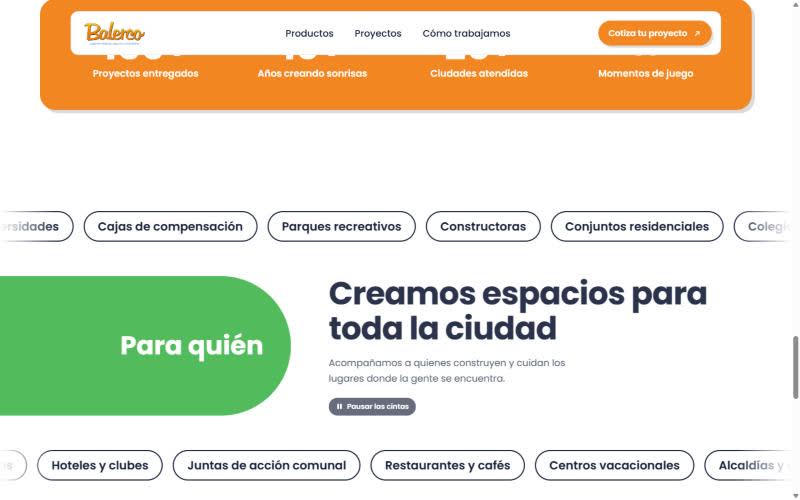
The four product lines and the sector ribbon, captured from the live site
A range that can be browsed, and work that can be checked.
Balerco has an address now instead of an attachment. The four lines open on the page, the installed parks are there to be looked at, the process is written down, and a buyer who wants to start can do it from a form on the same page rather than from a chat thread.
The site is live on its own domain, hand-coded and static — nothing to renew, nothing that breaks when a plugin updates — and the source sits in Balerco’s own repository, so the company owns what it paid for.
Design, front-end build and deployment, end to end, with the SEO groundwork the brief depended on.